 Gypsophilia spreads apace. However, unlike the days when we had sound benchmarks like the virtuosity of Bratsch, the authentic Roma roots of Taraf de Haidouks and the “proto-Gypsies” Musafir of Rajasthan, we now live in the post-Borat age of Gogol Bordello, Balkan Beat Box and Bucovina Club. Don’t get me wrong, I’d be the last to champion ‘purity’ in reference to Rom / Balkan inspired music given its inherently mongrel (in the very best sense of the term) nature. But – honestly – listening to Disko Partizani, I don’t know whether we haven’t entered the realm of perpetual pastiche seasoned with not a small dose of self-parody. Virtually no music is totally impervious to being re-fitted for the dance club floor and as Shantel and a cast of terrific musicians including the fantastic Canadian singer Brenna MacCrimmon amply demonstrate, Balkan music is just too perfect for the purpose. So, when Shantel sings “yabadaday yoboboboy, i wanna be a disco boy” or “My baby came down from Romania, She was the queen of Transylvania, But now we live in suburbia” over a ska beat, I simply grin broadly and say: Yakshemash! Very Nice!
Thursday, May 22, 2008
Shantel - Disko Partizani (Crammed)
Gypsophilia spreads apace. However, unlike the days when we had sound benchmarks like the virtuosity of Bratsch, the authentic Roma roots of Taraf de Haidouks and the “proto-Gypsies” Musafir of Rajasthan, we now live in the post-Borat age of Gogol Bordello, Balkan Beat Box and Bucovina Club. Don’t get me wrong, I’d be the last to champion ‘purity’ in reference to Rom / Balkan inspired music given its inherently mongrel (in the very best sense of the term) nature. But – honestly – listening to Disko Partizani, I don’t know whether we haven’t entered the realm of perpetual pastiche seasoned with not a small dose of self-parody. Virtually no music is totally impervious to being re-fitted for the dance club floor and as Shantel and a cast of terrific musicians including the fantastic Canadian singer Brenna MacCrimmon amply demonstrate, Balkan music is just too perfect for the purpose. So, when Shantel sings “yabadaday yoboboboy, i wanna be a disco boy” or “My baby came down from Romania, She was the queen of Transylvania, But now we live in suburbia” over a ska beat, I simply grin broadly and say: Yakshemash! Very Nice!


Etran Finatawa - Desert Crossroads (Riverboat)
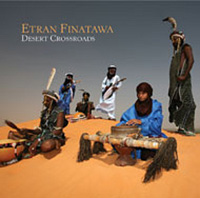 It’s gotta be hard to be the second (or third) band out of the Sahal following in the wake of the euphoric welcome extended to Tinariwen by the Globalistas. With western ears now attuned to Tuareg desert blues, it is virtually impossible not to contextualize Etran Finatawa without resorting to comparisons with Tinariwen. I guess that’s the way it goes with musical milestones. The familiar electric guitar work is present, but free of the crunchiness and hammer of the gods muscularity that characterizes the Tinariwen recordings. Considerably more space is made in the production for the percussion – notably the tendé drum and the water calabash – and acoustic guitar. Altogether it’s a much more subtle and understated affair. Etran Finatawa also distinguishes itself in that the band is evenly split between Tuareg and Wodaabe musicians and, stylistically and linguistically, the compositions reflect the two cultures, Etran Finatawa genuinely embodies a cultural crossroads in the desert and it’s a relief to know that the album’s title is not just another invocation of the tired blues trope – attempting to transpose Robert Johnson’s delta blues onto the desert sands.
Kronos Quartet & Wu Man - Terry Riley: The Cusp of Magic (Nonesuch)
 Commissioned by the Kronos Quartet in 2004 to mark his 70th birthday, Terry Riley’s The Cusp of Magic is just the latest gift the minimalist composer and the quartet have given one another in the course of an extraordinarily fruitful musical collaboration that has lasted thirty years. Riley has written more than 20 works for Kronos and their mutual, almost pathological, eclecticism is clearly an important ingredient in their partnership’s longevity. Superficially at least – despite the featured presence of pipa virtuoso Wu Man – The Cusp of Magic is not as conspicuous a cross-cultural exploration as Kronos’s non-Riley recordings Pieces of Africa, Nuevo or their brilliant adventures in Bollywood, You’ve Stolen My Heart. However, the six movements in this work are quite strikingly different from one another, drawing inspiration from musical traditions as various as First Nations peyote rituals, the North Indian gat, Chinese lullabies, Cuban montuno with a bit of theme music from a Russian cartoon thrown in for good measure. For lesser artists it could be a cauldron full toil and trouble, but after three decades hand in glove the charm of Terry Riley and the Kronos Quartet is firm and good.
Firewater - The Golden Hour (Bloodshot)
 Firewater’s Tod A really hates George W. Bush. So much so that Dubya’s re-election in 2004 drove the singer/songwriter into a three year period of self-imposed exile; during which he travelled, performed and recorded in a number of countries, including India, Pakistan, Turkey and Israel. The Golden Hour is the product of the peripatetic artist’s wanderings. Firewater’s blunt – at times a little leaden – lyrics sit on top of a solid rhythmic foundation provided by local musicians, with dhol, ghatam and djembe featured, depending on the setting. The Tel Aviv sessions include guitarist Uri Kinrot who sounds a lot like Marc Ribot, giving those tracks an eerily Tom Waits, Rain Dogs era atmosphere. The combination of global rhythms, political lyrics and Mr. A’s growling, almost sneering, vocals suggests that we might just have found an artist who can pick up where the sadly departed Joe Strummer left off with the Mescaleros.
Yael Naim & David Donatien - Yael Naim (Warner)
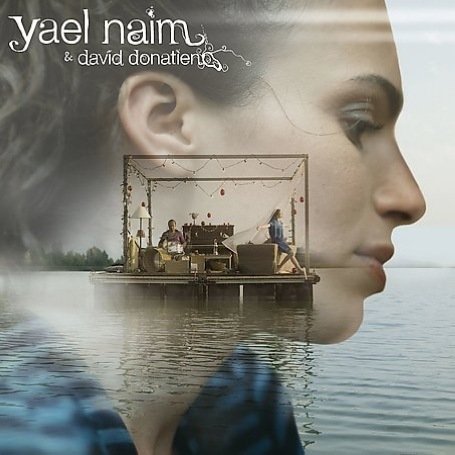 What precisely is the value of having one of your songs featured in an Apple commercial? Well, like a certain Calgary girl who cleaned up at this year’s Junos, young Israeli singer Yael Naim is finding out. Her decidedly Feist-y song “New Soul” was featured in the TV ad for the MacBook Air, which started running in January. And then, as all things digital do these days, the incredibly infectious ditty went viral. In February, with a grand total of three plays on reporting radio in the US, the song entered the top ten on the Billboard Hot 100 and had topped the iTunes sales list. As I type, in mid-May, the video of “New Soul” has had more than 8 million views on YouTube and is closing in fast on “1 2 3 4”. All of which leaves me wondering: with the MacBook Air starting at $1900 and “New Soul” available for download to my iPod for $0.99 from iTunes, just which revenue stream is flowing faster for Apple these days? I guess it doesn’t really matter, because they’ve got us coming and going – literally. Making Steve Jobs the most powerful A&R man on the planet.
Subscribe to:
Posts (Atom)

